
TEL:0086-18803691565
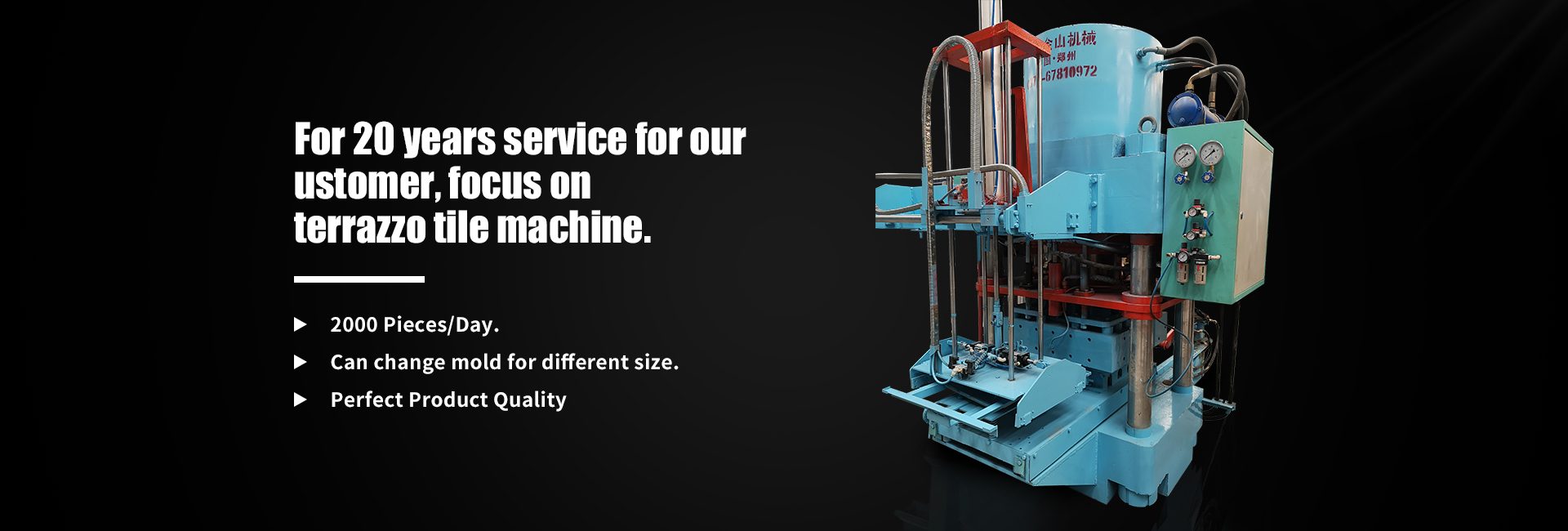
Terrazzo tile manufacturing is one of the few building-materials businesses that can be started at small scale, in a modest building, with equipment that payback in months rather than years. That is also why it attracts a lot of people who underestimate two things: curing space and colour consistency. Get those right and the plant runs; get them wrong and you produce tiles nobody reorders.
This guide walks through the actual sequence — market check, investment, line configuration, layout, staffing, unit cost, break-even — from the perspective of someone who builds the machines.
Terrazzo demand is not uniform. Before committing capital, answer these four questions with real local data, not intuition:
| Product choice | Implication for equipment |
|---|---|
| Single-layer utility tiles, one colour | Cheapest press, one feeder, minimal mixing complexity. Compete on price only. |
| Double-layer terrazzo, multiple colours | Second feeder required. Lower material cost per m², far better market position. This is the normal choice for a new commercial plant. |
| Large-format slabs (1200×600 and up) | Bigger press, bigger moulds, stronger handling equipment, more breakage risk in curing. Higher capital, higher price per m². |
| Polished finish in-house | Adds a multi-head polishing line plus water recycling. Enables selling finished product rather than green tile to a finisher. |
The most common mistake in a first plant is buying for the largest format you might someday make. Buy for the format you can sell this quarter; presses can be added, floorspace cannot be conjured.
The table below is structural: it shows the relative share each item takes in total investment. Actual amounts depend on your local equipment quotations, building material prices and labour rates — plug those in before you commit capital.
| Item | What it covers | Relative share of total |
|---|---|---|
| Terrazzo tile press | Main machine + moulds for 2–3 formats | High |
| Mixing & batching | Mixer, hoppers, metering, possibly pigment dosing | Medium |
| Pallet handling | Stacker, transfer, pallets themselves | Medium — the most underestimated line |
| Polishing / grinding | Multi-head machine + water recycling | High if in-house, zero if subcontracted |
| Building & floor | Covered hall, level reinforced slab, drainage | Often the single largest item |
| Curing capacity | Racks or steam chamber + pallet inventory | Medium to high |
| Power connection | Transformer / three-phase hookup | Varies enormously by site |
| Working capital | Raw material stock, wages, 60–90 days of receivables | Frequently the item that actually kills new plants |
Two things worth saying plainly. First, pallets are capital: the number of pallets you own sets how much tile can be in curing at once, which sets your real output ceiling. Second, running out of working capital after the equipment is installed is the standard failure mode — budget it as a line item from day one, not as a leftover.
A minimum viable line, in process order:
A small plant typically needs: one mixer/batching operator, one press operator, one or two people on pallet handling and curing, two to three on grinding and polishing, one packing/QC, plus a supervisor who owns colour matching and mix design. Total headcount per shift depends mainly on how much pallet handling is manual — fully manual handling roughly doubles the figure. The supervisor role is the one not to under-hire — colour consistency across batches is a skill, and it is what determines whether your second order arrives.
Build your cost model in this order, per m² of finished tile:
Then compare against your market price. The healthy version of this model has material cost as the dominant variable and labour as a modest one — that is what makes mechanised terrazzo competitive against hand-cast production. If your model shows labour dominating, the configuration is too manual for the price you are targeting.
If you have read this far, the next useful step is a concrete line proposal rather than more reading. Send us four numbers — target tile sizes, required m² per shift, whether you want single or double layer, and your local power supply — and we will return a configuration, mould list, power requirement and price, plus a layout drawing you can take to a builder.
→ Request a line proposal | Terrazzo tile machine | Polishing machine | Fully automatic production line
